
Workplace safety and dignity are now central to organisational compliance in India. The POSH training compliance India framework, governed by the Prevention of Sexual Harassment at Workplace Act, 2013, places clear obligations on employers to educate employees, managers, and Internal Committee members. Despite this, many organisations still overlook structured POSH training, especially in startups and fast growing companies.
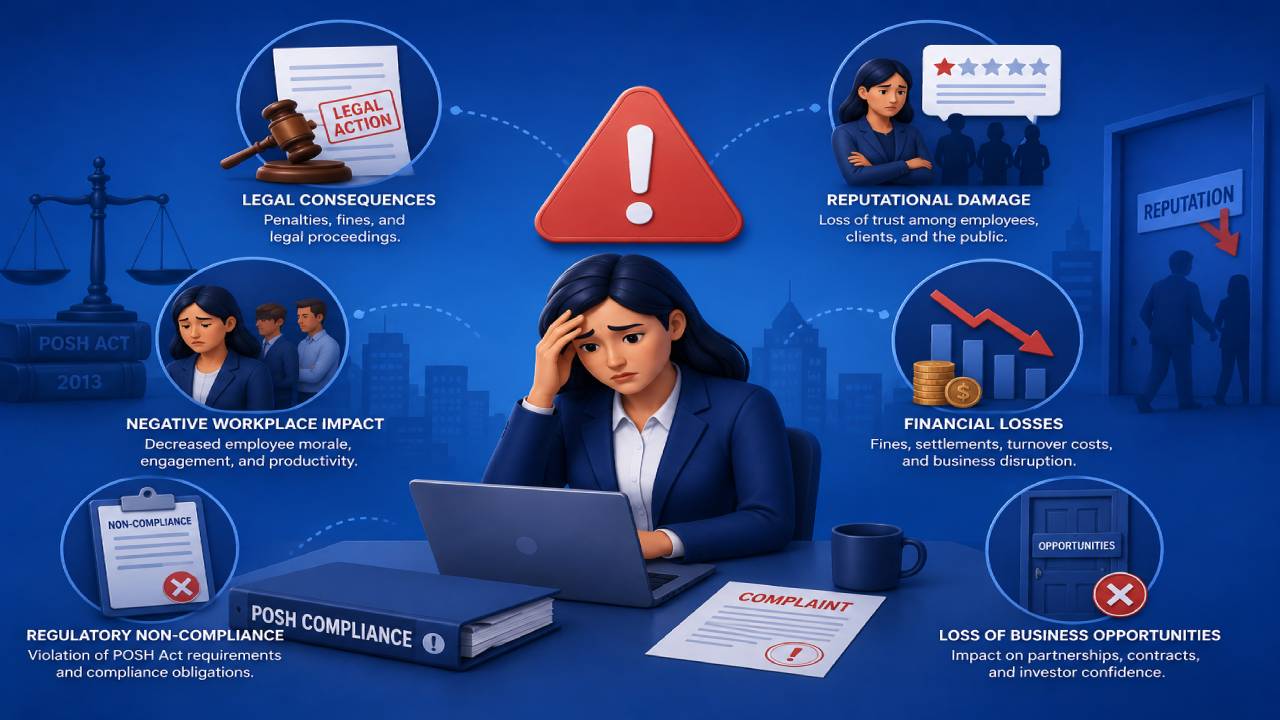
Failure to conduct proper POSH training is not a minor lapse. It creates legal exposure, weakens internal complaint mechanisms, and increases the risk of workplace harassment going unaddressed. Over time, this can damage employee trust, organisational reputation, and governance standards. Understanding what happens when POSH training is not provided helps companies take preventive action and build safer workplaces.
POSH training compliance India and its legal significance
POSH training compliance India is not only a best practice. It is a statutory expectation linked to employer responsibility under the law. The POSH Act requires organisations with ten or more employees to create awareness about sexual harassment policies, complaint procedures, and employee rights. Training ensures employees understand what constitutes inappropriate behaviour, how to report incidents, and how the Internal Committee functions. Without this awareness, even well drafted policies remain ineffective. Courts and labour authorities increasingly expect organisations to demonstrate proactive compliance rather than reactive responses after complaints arise.
What happens when POSH training is not conducted
When a company fails to provide POSH training, the first consequence is internal confusion. Employees may not recognise harassment or may not know how to report it. This leads to silence, delayed complaints, or informal escalation without documentation. From a legal standpoint, non training weakens the organisation’s defence during inquiry or litigation. If a harassment complaint reaches an external authority, the absence of training records may indicate negligence in compliance obligations. This can result in regulatory scrutiny and penalties under the POSH Act, including monetary fines for non compliance. In serious cases, repeated violations can lead to cancellation of business licences or restrictions imposed by authorities.
Impact on Internal Committee effectiveness
Every organisation must constitute an Internal Committee to handle complaints. However, the effectiveness of this committee depends heavily on employee awareness. Without training, employees may not approach the committee at all. Some may directly approach external forums or resign without reporting incidents. This bypasses the structured inquiry process and increases organisational risk. Even committee members require regular POSH training compliance India updates to understand procedural fairness, evidence handling, and legal timelines. Without this, inquiries may become inconsistent or legally vulnerable.
Legal risks and financial penalties for employers
Failure to conduct POSH training exposes employers to multiple legal risks. The law allows authorities to impose penalties for non compliance, which may include monetary fines. Repeat violations can attract higher penalties and stricter enforcement action. In addition, courts may interpret lack of training as negligence in providing a safe workplace. This can influence compensation orders in favour of employees during dispute resolution. In extreme situations, companies may also face reputational damage during regulatory inspections, tender evaluations, or corporate due diligence processes.
Increased workplace harassment risks
One of the most direct consequences of missing POSH training is an increase in workplace harassment incidents. Employees who are not aware of boundaries may unintentionally engage in inappropriate behaviour. Others may tolerate misconduct due to lack of awareness about reporting rights. This creates an unsafe workplace environment where harassment goes unreported or unresolved. Over time, this affects employee morale, productivity, and retention. Training acts as a preventive mechanism by setting behavioural expectations and reinforcing organisational culture.
Reputational damage and stakeholder trust issues
In today’s business environment, compliance is closely linked with reputation. Investors, clients, and business partners increasingly assess companies based on governance practices, including POSH compliance. A company found lacking POSH training compliance India standards may lose credibility during audits, partnerships, or funding discussions. Public disclosure of harassment cases without evidence of proper training can also impact brand image. Reputation recovery after such incidents is often slow and expensive compared to preventive compliance measures.
Challenges in handling POSH complaints without training
When employees are not trained, complaint handling becomes complex. Reports may be incomplete, delayed, or emotionally charged without factual clarity. This makes investigation difficult for the Internal Committee. Lack of awareness also leads to procedural errors such as missing timelines, improper documentation, or informal settlements outside the legal framework. These issues can invalidate or weaken the inquiry process. In some cases, employees may directly escalate matters to courts or labour authorities without using internal mechanisms, increasing legal exposure for the company.
Role of awareness in preventing compliance failures
Awareness is the foundation of POSH compliance. Regular training sessions help employees understand acceptable workplace behaviour, reporting channels, confidentiality norms, and legal protections. Many organisations conduct structured programs such as a posh awareness session to ensure employees at all levels understand their rights and responsibilities. These sessions also help reduce myths and fears around filing complaints. Training should not be a one time activity. It must be continuous to reflect changes in workforce structure, digital communication tools, and workplace dynamics.
Importance of external expertise in POSH compliance
Many companies struggle to design effective training internally. This is where external experts play a key role. A POSH Consultant in Noida or similar compliance specialist can help organisations develop training modules, review policies, and support Internal Committee functioning. External consultants bring legal expertise and practical experience from multiple industries. This ensures training is aligned with current legal expectations and workplace realities. They also help companies conduct audits and identify gaps before they turn into legal issues.
Digital workplaces and rising compliance challenges
Hybrid and remote work environments have introduced new compliance risks. Harassment may now occur through emails, chat platforms, video calls, and informal digital interactions. Without POSH training, employees may not recognise digital misconduct as a violation. This creates a grey area where inappropriate behaviour goes unreported. Training helps employees understand that POSH compliance applies equally in physical and virtual workplaces.
Organisational responsibility under POSH law
Employers have a statutory duty to provide a safe working environment. This includes policy creation, committee formation, awareness programs, and timely grievance handling. Failure to provide POSH training is often viewed as failure to fulfil this duty. Regulatory bodies expect organisations to demonstrate active compliance efforts, not just written policies. This makes training a critical component of corporate governance and risk management.
Long term business impact of non compliance
Ignoring POSH training does not only create immediate legal risks. It also affects long term organisational performance. High employee turnover, reduced trust in leadership, and low engagement are common outcomes in poorly trained workplaces. Recruitment and retention become difficult when workplace safety concerns are not addressed. Over time, this impacts growth, productivity, and organisational stability. Investing in training is therefore not only a compliance requirement but also a strategic business decision.
Building a strong POSH compliance culture
Strong compliance culture starts with leadership commitment. When senior management actively participates in training and awareness programs, employees are more likely to follow reporting systems. Clear communication, regular workshops, and accessible complaint mechanisms strengthen trust in the organisation. POSH training compliance India standards are best achieved when compliance becomes part of everyday workplace behaviour rather than a one time activity.
Conclusion
Failing to provide POSH training has serious consequences for organisations. It increases legal exposure, weakens internal processes, and damages workplace culture. More importantly, it puts employee safety and dignity at risk. POSH compliance is not limited to documentation or policy creation. It requires continuous education, awareness, and leadership involvement. Companies that invest in structured training create safer, more transparent, and more resilient workplaces. In the long run, compliance is not just about avoiding penalties. It is about building trust, protecting people, and ensuring sustainable business growth.