
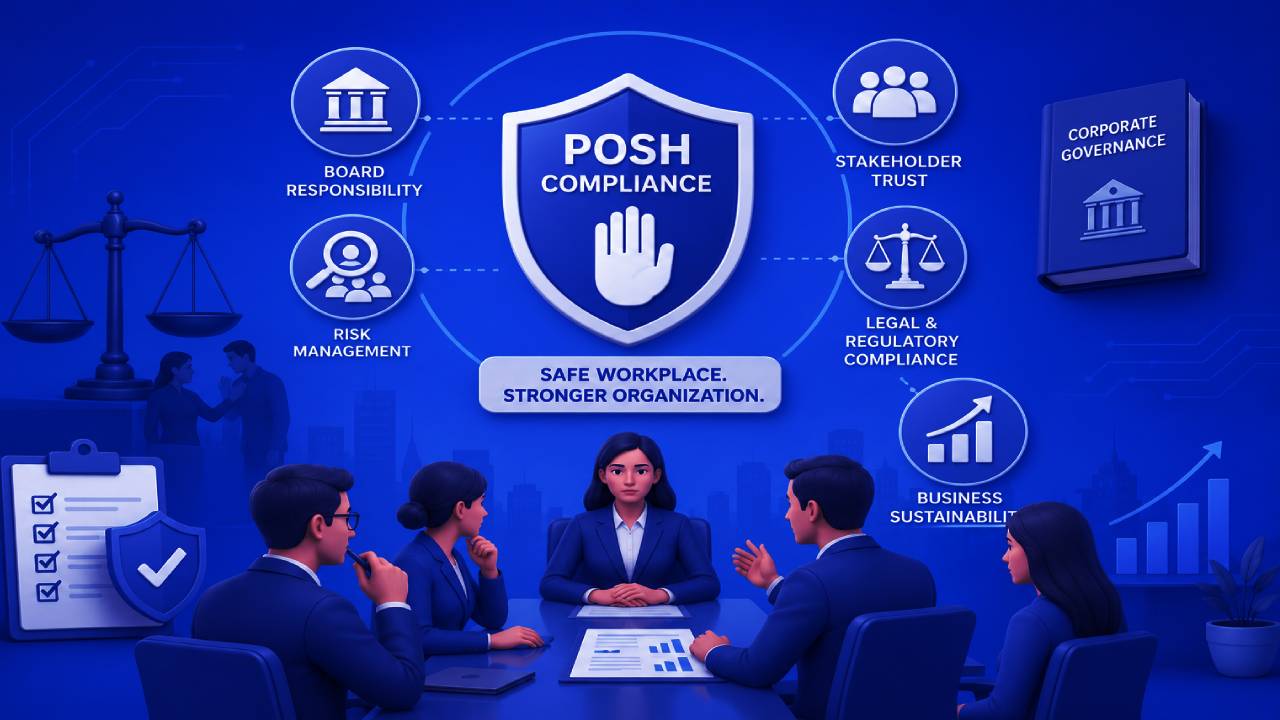
POSH Corporate Governance has moved far beyond a routine HR requirement. It is now a key element of board level responsibility, legal risk management, and organisational ethics. In modern workplaces, especially across Delhi NCR and other corporate hubs in India, companies are increasingly judged on how effectively they prevent and address workplace sexual harassment.
POSH Corporate Governance reflects how seriously an organisation treats employee safety, dignity, and compliance obligations under the Prevention of Sexual Harassment of Women at Workplace Act, 2013. What was once seen as an internal policy matter is now a measurable governance standard influencing reputation, investor confidence, and regulatory scrutiny.
POSH Corporate Governance
POSH Corporate Governance refers to the integration of workplace sexual harassment prevention systems into the overall governance and compliance structure of an organisation. It connects legal obligations under the POSH Act with leadership accountability and board level oversight. Earlier, POSH compliance was treated as a checklist exercise involving policy creation and formation of an Internal Committee. Today, expectations have shifted. Organisations are required to demonstrate continuous monitoring, structured reporting systems, employee awareness programmes, and effective complaint resolution mechanisms. This shift reflects a broader change in corporate accountability. Workplace conduct is no longer seen as an internal HR matter. It is now a governance indicator of ethical leadership and organisational integrity.
Why POSH Compliance Is Becoming a Governance Priority
POSH Corporate Governance has gained importance due to increasing legal enforcement and evolving workplace expectations. Courts and regulators now expect organisations to actively prevent harassment rather than respond after incidents occur. One major reason for this shift is legal liability. Employers can face penalties if they fail to constitute a proper Internal Committee or do not follow due process during investigations. In serious cases, non compliance may lead to reputational damage and operational restrictions. Another reason is reputational risk. In the digital era, workplace misconduct cases can quickly become public. This can impact investor trust, client relationships, and overall brand value. Governance frameworks now include employee safety as a core performance metric. This makes POSH compliance a board level concern rather than a purely operational function.
Legal Foundation Behind POSH Corporate Governance
The POSH Act places clear obligations on employers to ensure a safe working environment free from sexual harassment. These include policy implementation, Internal Committee formation, complaint handling procedures, and regular awareness initiatives. Organisations with ten or more employees are legally required to constitute an Internal Committee at each office location. This committee is responsible for receiving complaints, conducting inquiries, and recommending action. Annual reporting is also mandatory. Employers must submit details of complaints and resolutions to the district officer. Failure to comply may attract monetary penalties and legal consequences. Over time, judicial interpretations have strengthened employer accountability. Courts have emphasised the need for proactive compliance systems rather than reactive responses to complaints.
Shift From HR Function to Governance Responsibility
POSH Corporate Governance represents a shift from HR driven compliance to leadership driven accountability. While HR teams manage implementation, ultimate responsibility lies with senior management and the board. Boards are now expected to review POSH compliance metrics as part of governance reporting. This includes tracking complaint resolution timelines, training completion rates, and effectiveness of Internal Committees. This shift ensures that workplace safety is embedded into organisational strategy rather than treated as a standalone compliance activity.
Role of Leadership in POSH Governance
Leadership plays a decisive role in shaping POSH Corporate Governance. Senior executives set the tone for workplace behaviour and compliance culture. When leadership actively supports POSH policies, employees feel more confident in reporting incidents. Conversely, lack of leadership involvement often leads to underreporting and weak enforcement. Leaders are also responsible for ensuring accountability across departments. This includes monitoring policy implementation and ensuring corrective actions are taken when required. In many organisations, leadership commitment determines whether POSH compliance is effective or merely procedural.
Importance of Training in POSH Corporate Governance
Training is a core pillar of POSH Corporate Governance. It ensures employees understand acceptable workplace behaviour, reporting channels, and legal protections. Regular awareness programmes help reduce confusion and improve compliance culture across the organisation. They also ensure consistent understanding of policy expectations at all levels. Many companies invest in POSH training for corporate offices to strengthen employee awareness and reduce legal risks. Training also helps managers identify early signs of inappropriate behaviour and respond appropriately. Without proper training, even well designed policies may fail during real workplace situations.
Internal Committee as a Governance Mechanism
The Internal Committee is the backbone of POSH Corporate Governance. It ensures fair, confidential, and impartial handling of complaints. A properly functioning committee includes a presiding officer, employee representatives, and an external member with legal or social expertise. This structure ensures neutrality during investigations. Committees must follow strict timelines and maintain confidentiality throughout proceedings. Any breach of procedure can weaken compliance credibility and expose organisations to legal scrutiny. Regular evaluation of committee performance is now considered a governance best practice.
POSH Compliance as a Risk Management Tool
POSH Corporate Governance is closely linked with organisational risk management. Workplace harassment cases can lead to financial penalties, litigation, and reputational harm. Unresolved complaints may escalate into legal disputes or public controversies. This creates operational and financial risks for the organisation. By embedding POSH into governance systems, companies reduce exposure to such risks and improve internal accountability. It also strengthens investor confidence, as ethical governance practices are increasingly considered during funding and acquisition decisions.
Role of HR and Compliance Teams
Human Resources and compliance teams play an operational role in POSH implementation. They manage training programmes, maintain documentation, and support Internal Committees during investigations. However, HR alone cannot ensure governance level compliance. POSH Corporate Governance requires coordination between HR, legal departments, leadership teams, and external experts. Many organisations also engage a POSH consultant for corporates to strengthen internal systems, ensure legal accuracy, and improve compliance frameworks. This external support helps organisations align with evolving legal interpretations and best practices.
Digital Workplaces and POSH Governance
The rise of hybrid and remote work has expanded the scope of POSH Corporate Governance. Workplace communication now includes emails, messaging apps, video conferencing, and digital collaboration platforms. POSH laws apply to all workplace related interactions, including digital communication. This means inappropriate behaviour online can also lead to formal complaints and investigations. Organisations must therefore extend POSH policies to cover digital conduct clearly. Employees must be aware that professional standards apply across both physical and virtual environments.
Challenges in Implementing POSH Corporate Governance
Despite growing awareness, organisations face several challenges in implementing effective POSH governance. One common issue is inconsistent awareness across employee levels. While senior leadership may understand compliance requirements, middle management often lacks clarity on reporting procedures. Another challenge is ensuring uniform implementation across multiple office locations. Large organisations often struggle to maintain consistent compliance standards. Cultural barriers also play a role. In many workplaces, employees hesitate to report incidents due to fear of retaliation or stigma. These challenges highlight the need for continuous training and strong governance systems.
POSH Compliance and Organisational Reputation
POSH Corporate Governance has a direct impact on organisational reputation. Companies with strong compliance frameworks are perceived as safer and more ethical workplaces. This improves employee retention, recruitment success, and overall brand trust. On the other hand, weak compliance can significantly damage public perception and stakeholder confidence. In today’s competitive business environment, reputation is closely linked with governance quality. POSH compliance plays a major role in shaping this perception.
Future of POSH Corporate Governance in India
POSH Corporate Governance is expected to become more structured and data driven in the future. Organisations may increasingly adopt digital compliance tracking systems, automated reporting tools, and AI based risk monitoring solutions. Regulatory authorities are also expected to enhance scrutiny of workplace safety frameworks. This will require organisations to maintain stronger documentation and proactive compliance systems. As workplace models continue to evolve, POSH governance will remain a critical pillar of corporate responsibility in India.
Conclusion
POSH Corporate Governance is no longer optional or symbolic. It is a core element of modern corporate responsibility, legal compliance, and ethical leadership. Organisations that integrate POSH into their governance structure are better equipped to manage legal risk, protect employees, and maintain strong reputations. In today’s business environment, POSH compliance reflects not only regulatory adherence but also the quality of leadership and organisational values.