
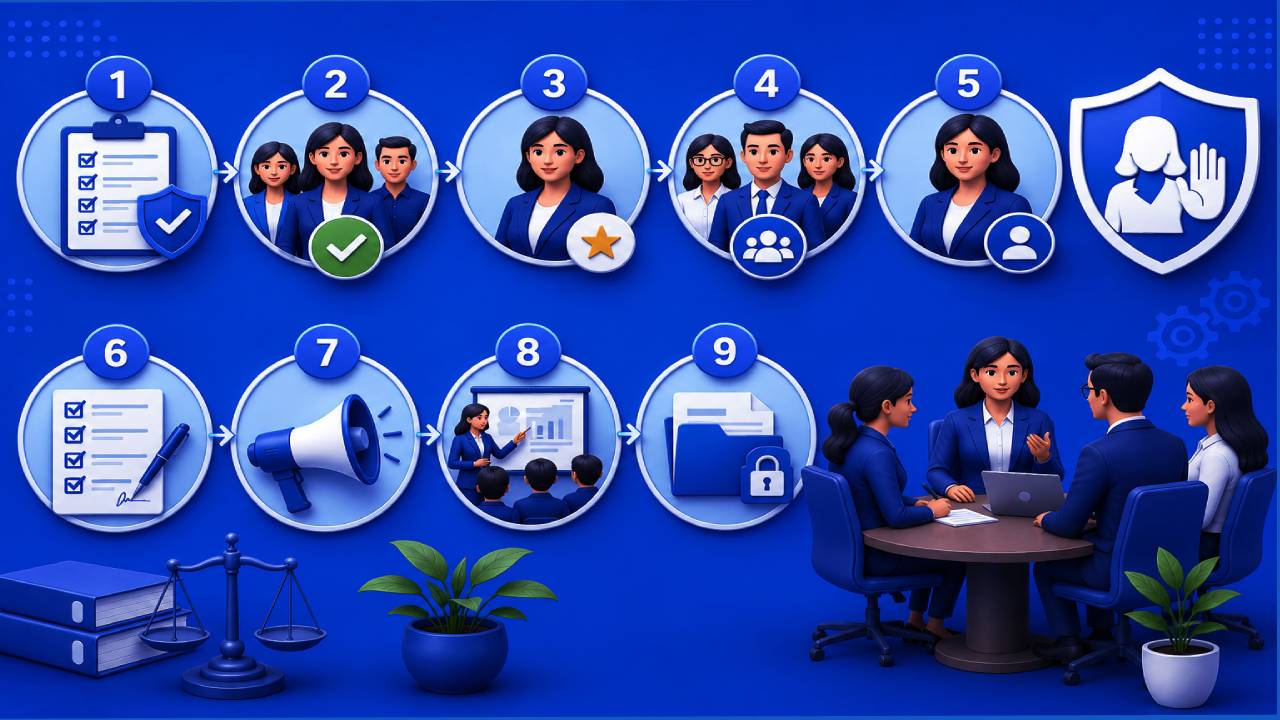
The Internal Complaints Committee plays a central role in ensuring workplace safety and legal compliance under the POSH Act, 2013 in India. Every organisation with ten or more employees must constitute this committee to address complaints of sexual harassment at the workplace in a structured, fair, and confidential manner. Despite this legal mandate, many businesses still struggle with proper formation, composition, and functioning of the committee.
An ineffective Internal Complaints Committee can weaken the entire compliance framework of an organisation. It can lead to delayed investigations, procedural errors, employee mistrust, and increased legal exposure. Understanding the correct steps for formation is therefore essential for both compliance and workplace integrity. This article explains how businesses can build a strong Internal Complaints Committee while aligning with legal expectations and best practices followed across Indian organisations.
Internal Complaints Committee and its legal importance in India
The Internal Complaints Committee, often referred to as ICC, is a statutory body established under the POSH Act. Its primary responsibility is to receive complaints, conduct impartial inquiries, and recommend actions in cases of workplace sexual harassment. The law ensures confidentiality, fairness, and protection for both complainant and respondent. The committee acts as an independent body within the organisation and is expected to function without bias or influence from management. A well structured Internal Complaints Committee strengthens workplace governance and helps organisations demonstrate compliance during audits, inspections, and legal proceedings.
Step 1: Understand statutory requirements before formation
Before forming the committee, organisations must clearly understand legal requirements under the POSH Act. Any workplace with ten or more employees is required to constitute an Internal Complaints Committee. The committee must include a Presiding Officer, internal members, and at least one external member with expertise in social work, law, or women’s rights. Gender balance and seniority considerations are important while selecting members. Failure to comply with these requirements can lead to penalties and non compliance findings during inspections.
Step 2: Appoint a qualified Presiding Officer
The Presiding Officer is the head of the Internal Complaints Committee. The law mandates that this position must be held by a senior woman employee within the organisation. If a suitable senior woman employee is not available, the employer may appoint a senior woman employee from another office or department of the organisation. This ensures neutrality and credibility in committee functioning. The Presiding Officer is responsible for leading inquiries, ensuring procedural fairness, and maintaining discipline during proceedings.
Step 3: Select internal committee members carefully
Internal members should be employees who are committed to fairness, confidentiality, and workplace ethics. They must understand organisational policies and demonstrate the ability to handle sensitive issues responsibly. These members assist in investigation, documentation, and decision making. They also ensure that proceedings follow internal policy guidelines along with legal requirements. Proper selection is critical because weak internal members can compromise the effectiveness of the entire committee.
Step 4: Appoint an external member with expertise
The presence of an external member is mandatory under the POSH framework. This individual must have experience in areas such as law, social work, or women’s welfare. The external member brings neutrality and independent judgment to the committee. Their role is particularly important in ensuring unbiased inquiry processes. Many organisations rely on experienced professionals or specialists recommended through legal networks or compliance experts.
Step 5: Provide structured training to ICC members
Training is one of the most important steps in forming an effective Internal Complaints Committee. Members must understand legal procedures, evidence handling, inquiry timelines, and confidentiality obligations. Without proper training, even a well constituted committee may struggle with procedural errors. Regular training ensures consistency and legal compliance during investigations. Many organisations conduct a structured posh awareness training program to educate committee members and employees about workplace conduct and complaint mechanisms.
Step 6: Define clear roles and responsibilities
Each member of the Internal Complaints Committee must have clearly defined responsibilities. This includes complaint intake, documentation, inquiry coordination, witness interviews, and report preparation. Clarity in roles prevents confusion and ensures smooth functioning during sensitive cases. It also improves accountability within the committee. Organisations should document these roles formally in their POSH policy to avoid ambiguity.
Step 7: Establish a transparent complaint mechanism
A strong Internal Complaints Committee must be supported by a clear complaint mechanism. Employees should know how to file complaints, whom to approach, and what timelines apply. Multiple reporting channels such as email, physical submission, or designated grievance officers should be available. Confidentiality must be maintained at every stage. Transparency builds trust and encourages employees to report incidents without fear.
Step 8: Ensure independence and neutrality of the committee
Independence is a key requirement for any Internal Complaints Committee. Members must not be influenced by senior management or organisational hierarchy during investigations. Decisions should be based on evidence, witness statements, and procedural fairness. External oversight can further strengthen neutrality. Organisations often consult a POSH Consultant in Delhi to ensure the committee is structured and functioning in line with legal expectations.
Step 9: Maintain proper documentation and records
Documentation is critical for legal compliance. The Internal Complaints Committee must maintain detailed records of complaints, inquiry proceedings, evidence, findings, and recommendations. Proper documentation ensures transparency and provides legal protection in case of external review or litigation. It also helps organisations track patterns and improve workplace policies. Confidentiality must be strictly maintained while handling records.
Step 10: Conduct periodic review and audits
An effective Internal Complaints Committee is not a one time setup. It requires regular review and updates to remain effective. Organisations should periodically assess committee performance, training effectiveness, and complaint handling efficiency. Policy updates should reflect changes in law or workplace structure. Regular audits help identify gaps and improve compliance standards over time.
Challenges businesses face while forming ICC
Many organisations face challenges during formation of the Internal Complaints Committee. These include lack of trained members, unclear understanding of legal requirements, and difficulty in appointing external experts. Smaller companies often struggle with resource limitations, while larger organisations may face coordination issues across multiple branches. Inadequate training and poor awareness are among the most common reasons for ineffective committees.
Importance of leadership commitment in ICC effectiveness
Leadership support plays a crucial role in ensuring committee success. When senior management prioritises compliance, employees feel more confident in reporting incidents. Leaders must promote a culture of respect, accountability, and zero tolerance towards harassment. Without leadership involvement, even a well structured committee may struggle to function effectively.
Role of awareness in strengthening ICC performance
Awareness is essential for the success of the Internal Complaints Committee. Employees must understand what constitutes harassment, how to report it, and what protections are available under the law. Regular workshops, communication campaigns, and onboarding sessions help reinforce awareness across the organisation. Many companies integrate awareness programs with compliance initiatives to improve overall effectiveness.
External expertise in ICC formation and compliance
Many organisations seek external support to strengthen their Internal Complaints Committee. Legal experts and compliance specialists provide guidance on structure, training, and documentation.External consultants help ensure that the committee meets statutory requirements and follows best practices in investigation and reporting. Professional support reduces compliance risks and improves operational efficiency.
Conclusion
Forming an effective Internal Complaints Committee is not just a legal requirement but a critical part of workplace governance. A well structured ICC ensures fair complaint handling, protects employee rights, and strengthens organisational credibility. Businesses must focus on proper composition, training, independence, and continuous review to ensure effectiveness. Leadership support and employee awareness further enhance committee performance. In today’s regulatory environment, organisations that invest in strong Internal Complaints Committee frameworks are better positioned to build safe, compliant, and trustworthy workplaces.