
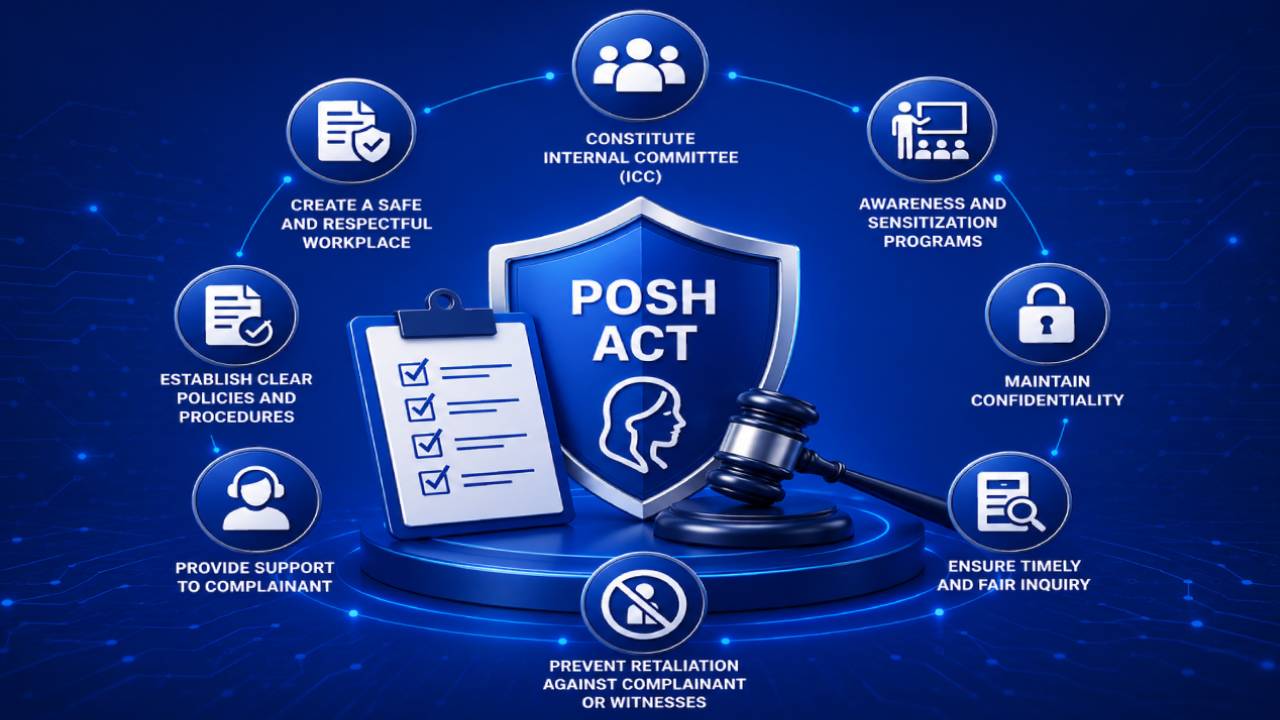
Workplace safety remains a legal and ethical priority for organisations across India. Understanding employer responsibilities under the POSH Act is essential for companies operating in Delhi NCR. The Prevention of Sexual Harassment of Women at Workplace Act, 2013 places clear obligations on employers to ensure a safe, respectful, and inclusive work environment. Employers must go beyond policy creation and actively implement systems to prevent harassment, address complaints, and promote awareness. Failure to meet these responsibilities can lead to legal penalties, reputational damage, and loss of employee trust. This article provides a comprehensive guide to employer duties under the POSH framework and how organisations in Delhi NCR can ensure full compliance.
Employer responsibilities under POSH Act and legal expectations
The employer responsibilities under the POSH Act are clearly defined within the legislation. The law requires organisations with ten or more employees to establish mechanisms to prevent and address workplace harassment. Employers must provide a safe working environment free from harassment and intimidation. This includes both physical and virtual workspaces. The Act also mandates the formation of an Internal Committee to handle complaints. Employers must ensure employees are aware of their rights and responsibilities. This involves communication of policies, training sessions, and visible commitment to workplace safety. The law places accountability directly on employers. Compliance cannot be delegated entirely to HR teams or external consultants.
Establishment of Internal Committee
One of the most important responsibilities involves setting up an Internal Committee. This committee acts as the primary body for addressing complaints related to workplace harassment. The committee must include a Presiding Officer who is a senior woman employee. It should also include at least two employees familiar with workplace issues and one external member with relevant expertise. Employers must ensure the committee functions independently and maintains confidentiality during proceedings. Proper training of committee members is also essential to ensure fair and unbiased inquiries. Failure to establish a compliant committee may result in penalties under the law.
Duty to provide a safe working environment
Employers are legally obligated to create a workplace where employees feel secure and respected. This responsibility extends beyond preventing incidents and includes proactive measures. Workplace infrastructure, policies, and culture must support safety and dignity. Employers should take steps to eliminate situations which may lead to harassment or discomfort. A safe environment also requires clear reporting mechanisms. Employees must know how to raise concerns and feel confident about receiving fair treatment. This responsibility applies equally to office premises, remote work settings, and client locations.
Importance of policy implementation and communication
A well drafted POSH policy forms the foundation of compliance. However, its effectiveness depends on implementation and communication. Employers must ensure the policy is accessible to all employees. It should clearly define prohibited behaviour, complaint procedures, and consequences of misconduct. Regular communication helps reinforce policy awareness. Employees must understand how to report concerns and what to expect during the inquiry process. Displaying policy details in common areas and digital platforms ensures visibility. This step demonstrates organisational commitment to workplace safety.
Role of training and awareness programmes
Training plays a central role in fulfilling employer responsibilities under POSH Act. Awareness programmes help employees understand acceptable behaviour and legal rights. Many organisations conduct posh awareness training sessions to educate employees about workplace conduct and reporting procedures. These sessions also help reduce stigma associated with reporting incidents. Training should not remain a one time activity. Regular sessions ensure new employees receive guidance and existing employees stay updated on legal requirements. Employers must also ensure specialised training for Internal Committee members. This prepares them to handle complaints with sensitivity and professionalism.
Complaint handling and inquiry process
Employers must establish a structured system for receiving and addressing complaints. The process must remain confidential, unbiased, and timely. When a complaint is filed, the Internal Committee conducts an inquiry following principles of natural justice. Both parties receive an opportunity to present their case. Employers must support the committee by providing necessary resources and ensuring cooperation from employees. This includes facilitating witness participation and access to relevant documents. Once the inquiry concludes, the employer must act on the committee’s recommendations within the prescribed timeframe. Timely action demonstrates commitment to compliance and justice.
Documentation and reporting obligations
Maintaining accurate records forms an essential part of compliance. Employers must document policies, training sessions, committee meetings, and inquiry proceedings. Annual reporting is another important responsibility. Organisations must submit details of complaints and actions taken to relevant authorities. Proper documentation ensures transparency and accountability. It also protects organisations during legal scrutiny or audits. Consistent record keeping allows companies to track patterns and improve workplace policies over time.
Addressing challenges in implementation
Despite clear legal requirements, organisations often face challenges in implementing POSH compliance. Lack of awareness among employees can hinder effective reporting of incidents. Maintaining confidentiality during inquiries may also prove difficult in close knit teams. Employers must establish strict protocols to protect privacy. Hybrid and remote work environments introduce new challenges. Communication gaps and digital interactions require updated policies and training approaches. Employers must adapt to these challenges by continuously reviewing and strengthening their compliance strategies.
Legal support and expert guidance
In complex situations, employers may require legal assistance to ensure proper handling of cases. Consulting a Posh lawyer can help organisations navigate legal procedures and maintain compliance. Legal experts provide guidance on policy drafting, inquiry processes, and risk mitigation. Their involvement ensures organisations adhere to legal standards and avoid procedural errors. Professional support also helps employers manage sensitive cases with greater confidence and clarity.
Consequences of non compliance
Failure to meet employer responsibilities under POSH Act can lead to serious consequences. Organisations may face financial penalties, legal action, and reputational damage. Non compliance can also affect employee trust and morale. A workplace perceived as unsafe may struggle to retain talent and maintain productivity. In severe cases, repeated violations may lead to cancellation of business licences. These risks highlight the importance of proactive compliance.
Building a culture of respect and accountability
Compliance should not be treated as a mere legal requirement. Employers must focus on creating a workplace culture rooted in respect and accountability. Encouraging open communication allows employees to raise concerns without fear. Leadership must demonstrate commitment through consistent actions and transparent communication. A culture of respect reduces incidents of misconduct and strengthens organisational relationships. It also enhances employee engagement and satisfaction. Employers who prioritise culture alongside compliance achieve sustainable workplace safety.
Conclusion
Understanding and fulfilling employer responsibilities under the POSH Act is essential for organisations in Delhi NCR. Compliance requires a combination of legal awareness, structured systems, and continuous effort. From establishing Internal Committees to conducting training and maintaining documentation, each responsibility contributes to workplace safety. Employers must remain proactive in addressing challenges and adapting to evolving work environments. By prioritising prevention, education, and accountability, organisations can create safe and inclusive workplaces. This approach not only ensures legal compliance but also strengthens employee trust and organisational reputation.