
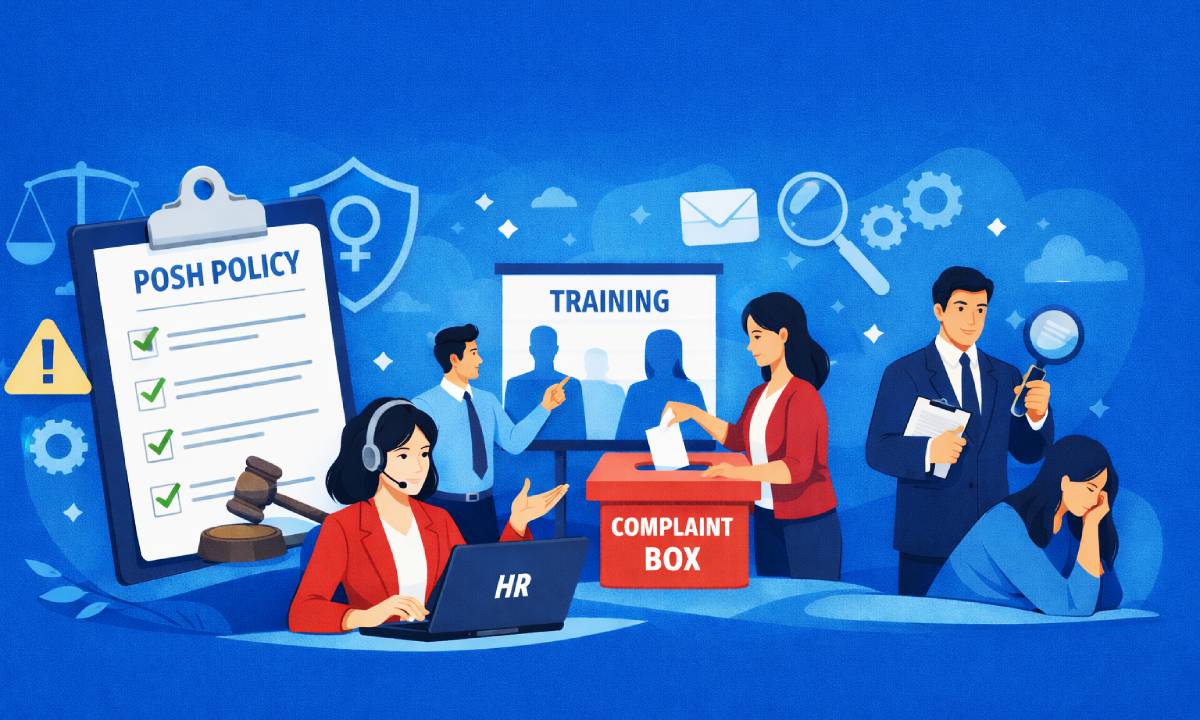
Workplace compliance under Indian law extends beyond written policies and internal declarations. POSH Compliance has become a core governance obligation for employers across sectors, driven by increased regulatory scrutiny, employee awareness, and judicial interpretation. Many organisations continue to struggle with implementation because they approach compliance as a one-time task rather than an ongoing legal responsibility.
POSH Compliance in India requires employers to follow a structured framework under the Sexual Harassment of Women at Workplace Act. This guide explains the compliance process step by step, helping employers understand their statutory duties, implementation challenges, and practical solutions.
Legal Framework Governing POSH Compliance in India
The Sexual Harassment of Women at Workplace Act, 2013 establishes a mandatory compliance framework for employers. It applies to all organisations employing ten or more employees, regardless of sector or ownership structure. Guidance and clarifications issued by the Ministry of Women and Child Development emphasise employer responsibility for prevention, redressal, and reporting. Courts have consistently held employers accountable for failure to implement the Act in substance, not merely in form. Compliance obligations apply to physical offices, remote work arrangements, work-related travel, and virtual interactions.
Why POSH Compliance Is a Governance Priority?
POSH Compliance is no longer viewed as a human resources function alone. It is now closely linked to corporate governance, risk management, and organisational culture. Regulators assess whether employers have taken reasonable steps to prevent harassment and respond effectively to complaints. Investors, clients, and partners increasingly examine compliance records during due diligence. Failure to comply exposes organisations to penalties, litigation risk, and reputational damage.
Understanding POSH Compliance
POSH Compliance refers to the continuous fulfilment of statutory obligations under the Act. This includes policy formulation, constitution of an Internal Complaints Committee, awareness initiatives, complaint handling, documentation, and annual reporting. Compliance must be demonstrable. Authorities examine whether systems function effectively in practice and whether employees have meaningful access to redressal mechanisms. Employers must therefore adopt a structured and documented approach.
Step One: Drafting and Implementing a POSH Policy
The first step in compliance is adopting a POSH policy aligned with statutory definitions and procedures. The policy must clearly define sexual harassment, reporting mechanisms, inquiry procedures, and consequences of misconduct. Merely circulating a policy is insufficient. Employers must ensure accessibility and employee awareness. Policies should be communicated during onboarding and periodically thereafter. A well-drafted policy forms the foundation of compliance.
Step Two: Constitution of the Internal Complaints Committee
The Act mandates the constitution of an Internal Complaints Committee for every workplace with ten or more employees. The ICC must include a senior woman employee as Presiding Officer, internal members, and an external member with relevant expertise. Improper constitution invalidates inquiry proceedings. Authorities and courts closely examine ICC composition during disputes. Employers must maintain documentation evidencing valid appointment and tenure.
Step Three: Training and Sensitisation
Training is a statutory obligation, not a best-practice add-on. Employers must conduct awareness programmes for employees and specialised training for ICC members. Training helps employees understand acceptable behaviour and reporting processes. It also equips ICC members to conduct fair and lawful inquiries. Lack of training is frequently cited as a compliance failure during inspections.
Step Four: Complaint Receipt and Inquiry Process
POSH Compliance requires employers to maintain a clear and accessible complaint mechanism. Complaints must be acknowledged promptly and handled confidentially. The ICC must follow principles of natural justice, provide equal opportunity to both parties, and adhere to statutory timelines. Inquiry findings must be reasoned and evidence-based. Procedural lapses often lead to legal challenges.
Step Five: Implementation of ICC Recommendations
Compliance does not end with inquiry findings. Employers must implement ICC recommendations within prescribed timelines. Failure to act on recommendation ns weakens compliance and exposes employers to penalties. Documentation of actions taken is essential. Authorities treat implementation as a key compliance indicator.
Step Six: Record Maintenance and Confidentiality
Accurate record keeping supports every stage of compliance. Employers must maintain complaint registers, inquiry reports, training records, and ICC meeting minutes. Confidentiality obligations apply strictly. Disclosure of identities or sensitive information may attract separate legal consequences. Secure storage and restricted access are critical.
Step Seven: Annual Reporting Obligations
Every employer must submit an annual POSH report to the District Officer. This report summarises complaints received, resolved, pending, and actions taken during the year. Nil reporting is mandatory even when no complaints are received. Non-submission or delayed filing is treated as non-compliance. Annual reporting provides authorities with a compliance overview.
Industry-Specific POSH Compliance Challenges
Different industries face distinct implementation challenges. IT companies must address virtual harassment risks. Manufacturing units must extend compliance to contract workers. Healthcare institutions must manage patient-related complaints. Educational institutions face complex power dynamics involving faculty and students. Startups often struggle with early-stage compliance awareness. Employers must tailor compliance frameworks to industry realities.
Role of External Expertise in Compliance Management
Complex organisational structures, multiple locations, or sensitive cases often require expert review. External support strengthens compliance accuracy and neutrality. Many organisations rely on POSH Consulting Services in Delhi, India to review policies, train ICC members, and audit compliance frameworks. Independent oversight enhances credibility and reduces risk.
Common POSH Compliance Mistakes Employers Make
A common mistake is treating compliance as a one-time exercise. Another is appointing ICC members without relevant training or independence. Employers also frequently overlook annual reporting or fail to update ICC tenure. Informal handling of complaints without ICC involvement is another serious lapse. Periodic compliance review helps prevent these errors.
Regulatory and Judicial Scrutiny Trends
Authorities increasingly focus on implementation rather than documentation alone. Courts examine whether employers acted promptly, fairly, and transparently. Judicial decisions show little tolerance for procedural lapses, especially where employee rights are compromised. Staying updated with legal developments supports proactive compliance.
Integrating POSH Compliance into Organisational Culture
Sustainable compliance requires leadership commitment. Senior management involvement signals seriousness and accountability. Clear communication, consistent enforcement, and regular training embed compliance into organisational culture. When compliance becomes part of everyday operations, risks reduce significantly.
Alignment With Broader Legal Obligations
POSH Compliance intersects with labour law, service rules, and corporate governance frameworks. Employers must ensure consistency across policies and procedures. Many organisations align POSH systems with broader posh act compliance initiatives to ensure uniform application across locations and departments. Integrated compliance strengthens governance and defensibility.
Conclusion
POSH Compliance in India requires a structured, proactive, and continuous approach. Employers must move beyond minimal adherence and focus on effective implementation across policy, training, inquiry, and reporting. When compliance is treated as a governance responsibility rather than an administrative task, organisations create safer workplaces and reduce long-term legal risk. A well-implemented POSH framework protects employees, strengthens trust, and reinforces organisational integrity.