
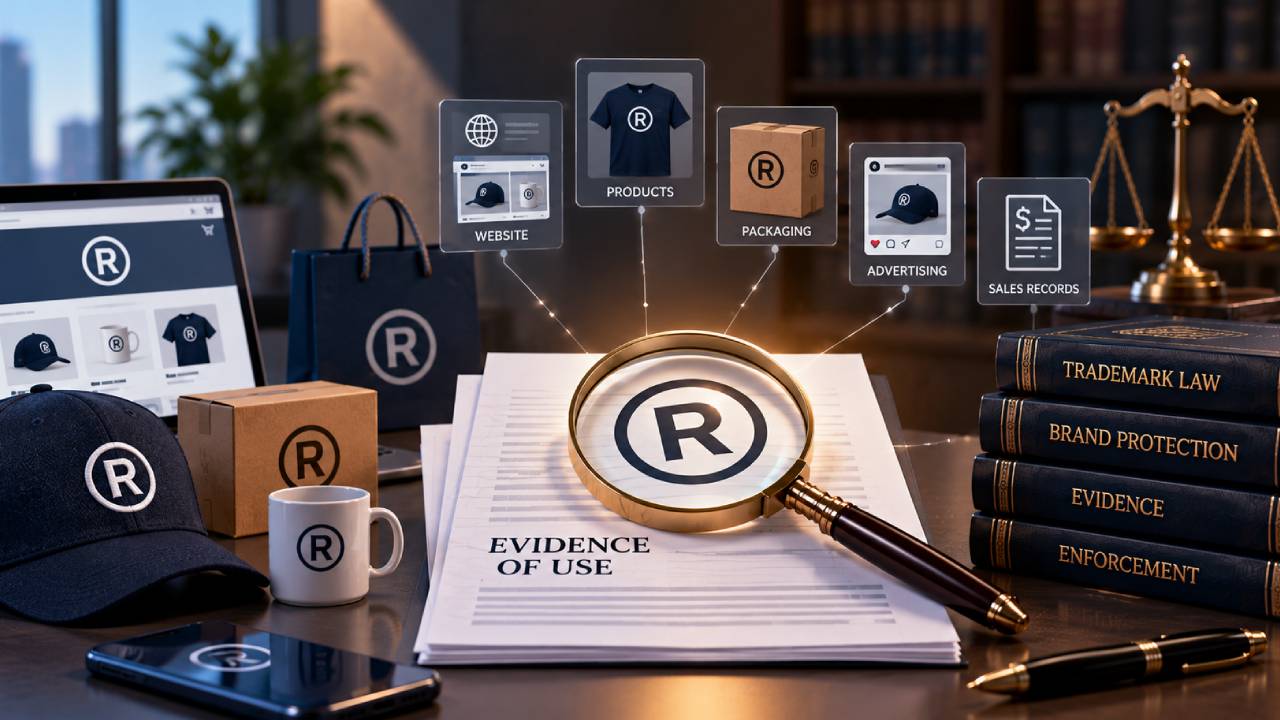
A trademark can become one of the most valuable assets of a growing business. Yet registration alone does not always tell the complete story of how a brand is being used in the marketplace. Businesses should maintain reliable Trademark Use Evidence to demonstrate genuine commercial use, support enforcement efforts and defend their rights when challenged. Evidence can also become important during renewal, opposition, cancellation or infringement proceedings, depending on the jurisdiction involved. A well organised record of trademark use gives businesses greater clarity over their rights and can strengthen their position when protecting a brand.
What Is Trademark Use Evidence?
Trademark use evidence refers to records showing how a trademark has been used commercially in connection with the goods or services covered by the relevant rights. The precise requirements vary between jurisdictions, so businesses should understand the rules applying to each market in which they seek protection. Evidence may include product packaging, labels, invoices, catalogues, advertisements, websites, online listings, promotional materials and other commercial records. The important consideration is usually whether the evidence demonstrates genuine use of the mark in connection with the relevant goods or services.
The United States Patent and Trademark Office, for example, requires trademark applicants and registrants to provide specimens showing how a mark is used in commerce in certain filing situations. The USPTO explains that an acceptable specimen should show the mark as consumers encounter it in connection with the relevant goods or services. This illustrates why businesses should not treat evidence as an administrative formality. The quality and relevance of records can affect the ability to establish and maintain trademark rights.
Why Evidence of Trademark Use Matters?
Trademark rights can face challenges long after registration. Another party may question whether a mark has been genuinely used, dispute its scope or seek cancellation based on non use where the applicable law permits such action. Maintaining evidence helps a business demonstrate its commercial history. It can show when a mark was adopted, where it was used, which goods or services were sold under it and how the brand was presented to customers.
Evidence can also help establish continuity. A single advertisement may demonstrate use at one point in time, but a consistent collection of records can provide a stronger picture of ongoing commercial activity. For brand protection, this distinction matters. Businesses often invest significant resources in developing goodwill around a trademark. If the underlying records are incomplete, proving the extent of that use may become more difficult during a dispute.
Trademark Use and Genuine Commercial Activity
Not every reference to a trademark necessarily constitutes genuine commercial use. Trademark offices and courts may apply specific legal tests when assessing whether a mark has been used in commerce. The nature of the goods or services, the way the mark appears, the target market and the commercial context can all be relevant. Businesses should therefore avoid assuming every marketing reference will qualify as evidence.
For example, displaying a mark prominently on packaging may provide useful evidence for goods. For services, the mark may appear on websites, advertisements, invoices, signage or other materials associated with the provision of those services. The evidence should also correspond with the goods and services covered by the trademark registration. Records relating to unrelated commercial activities may have limited value.
Types of Evidence Businesses Should Maintain
Businesses should maintain records capable of showing actual commercial use over time. Product packaging and labels can be particularly useful for businesses selling physical goods. Photographs of products, displays and retail environments can also preserve evidence of how the mark appeared in the marketplace. Commercial documents may provide another important source. Invoices, purchase orders, sales records and distribution documents can help establish genuine transactions involving branded goods or services.
Digital evidence has become increasingly important. Websites, ecommerce listings, social media posts, digital advertisements and online catalogues can demonstrate how a mark has been presented to consumers. Businesses should preserve dated versions where possible because online content can change or disappear. Advertising records may also be valuable. Campaign materials, brochures, promotional emails and paid advertising records can help establish how a brand was promoted. The relevance of each record depends on the jurisdiction and the circumstances of the dispute. Businesses should therefore focus on maintaining a broad and reliable evidence trail rather than relying on a single type of document.
Evidence Should Show the Mark Clearly
The evidence should make it possible to identify the trademark being used. If the registered mark differs substantially from the mark appearing in commercial materials, questions may arise about whether the use supports the relevant registration. Changes to logos, wording, typography or other brand elements can create complications. A business may gradually update its branding without considering whether the revised presentation remains consistent with its registered mark.
For this reason, businesses should retain records of significant brand changes. Historical versions of packaging, websites, advertising materials and logos can help establish how the mark evolved. Businesses should also distinguish between use of the mark as a trademark and decorative or descriptive use. The legal significance of a particular presentation depends on the applicable law and the facts of the case.
Keep Evidence Connected to Specific Goods and Services
Trademark registrations are normally divided into particular classes of goods and services. Evidence should therefore be organised so the business can demonstrate use in relation to the relevant commercial activities. A company may own a broad trademark portfolio covering several classes while actively using only some of them. If a challenge arises, the business may need to identify evidence corresponding to specific goods or services. Maintaining records by trademark, jurisdiction and class can make this process easier. It can also help identify areas where a registration may no longer reflect the company’s actual commercial activities. Businesses expanding into new product categories should update their trademark strategy rather than assuming an existing registration will automatically cover every future activity.
The Role of Evidence in Trademark Disputes
Trademark disputes often involve questions about ownership, priority, similarity, reputation or commercial use. Evidence can help establish the factual background needed to assess these issues. For example, dated records may help demonstrate when a business began using a particular mark. Sales records can provide information about commercial scale. Advertising materials may demonstrate market exposure, while customer communications can sometimes help show recognition of the brand. Evidence does not automatically determine the outcome of a dispute. Legal standards differ between jurisdictions and each case depends on its facts. However, organised evidence can give legal representatives a clearer basis for assessing the strength of a business’s position. Where a dispute becomes contentious, businesses may benefit from advice from TM Lawyers for Brand Protection who can assess the available records and identify gaps before formal proceedings or negotiations progress.
Evidence in Trademark Renewal and Maintenance
Many jurisdictions require trademark owners to meet ongoing requirements after registration. These requirements can include declarations of use, renewal filings or evidence demonstrating continued commercial activity. The specific rules differ considerably. In the United States, for example, trademark owners must file particular maintenance documents during prescribed periods and provide appropriate specimens or other evidence of use where required. Businesses with international portfolios should therefore maintain a calendar of relevant deadlines. Evidence should be collected before filings become due rather than assembled at the last moment. A central evidence management system can help businesses identify which records relate to which registrations and jurisdictions.
How Evidence Can Support Enforcement?
Evidence of use can also be valuable when enforcing trademark rights against third parties. A business may need to demonstrate ownership, commercial activity or the scope of its brand presence when sending a legal notice or submitting a complaint. Online enforcement creates additional challenges. Social media posts, marketplace listings and websites can change quickly. Businesses should preserve relevant material when potential infringement is discovered. Screenshots can be useful, but businesses should also record dates, URLs, account information and other relevant details. Where appropriate, more formal methods of preserving digital evidence may be considered. A consistent evidence management process can therefore support both defensive and offensive brand protection.
Digital Evidence Has Become Increasingly Important
Modern businesses often build their brands through digital channels. Websites, social media platforms, ecommerce marketplaces and online advertising can generate substantial evidence of commercial use. However, digital evidence presents practical problems. Websites can be redesigned. Product listings can disappear. Social media posts can be edited or removed. Advertising campaigns may only run for short periods. Businesses should therefore consider preserving important digital records regularly. Archived webpages, dated screenshots, campaign records and downloadable advertising materials can help maintain a historical record. The business should also retain supporting commercial information where available. A screenshot may show how a mark appeared, but invoices, sales data or advertising records may provide additional context regarding genuine commercial activity.
How Businesses Can Organise Trademark Use Records?
An effective evidence system should make records easy to locate. Businesses with multiple trademarks should avoid storing all material in an unstructured folder. Records can be organised by trademark, jurisdiction, goods or services and year. Important documents should include relevant dates and information about where and how the mark was used. Marketing and sales teams should understand the importance of retaining brand records. Legal teams should also communicate with commercial departments so relevant evidence is not lost during routine business changes. Businesses should be particularly careful during mergers, acquisitions, rebranding exercises and changes of suppliers. Older evidence can become difficult to obtain once systems or commercial relationships change.
Common Problems With Trademark Use Evidence
One common problem is relying on outdated records. Old packaging or advertising may establish historical use but may not demonstrate current commercial activity where current evidence is required. Another issue is incomplete information. A screenshot without a date or URL may have less evidential value than a properly documented record. Businesses may also maintain evidence for the wrong goods or services. This can happen when a trademark portfolio has expanded over time while actual commercial activities have changed. A further concern is inconsistent use. If the registered mark and the mark used in commerce differ significantly, businesses may need to assess whether the variation affects their rights. These issues are easier to address when identified early.
When Professional Legal Guidance Can Help
Trademark evidence can involve technical legal questions. A business may have thousands of commercial records but still lack evidence relevant to a particular legal requirement. Professional review can help identify which records are useful, where gaps exist and whether the business’s actual use aligns with its registrations. Legal professionals can also assist when a business receives a non use challenge, faces an opposition or needs to prepare evidence for enforcement. An Intellectual Property Lawyer in India can also help Indian businesses review their trademark portfolios, commercial use and evidence requirements when protecting brands in domestic or international markets. The objective should not simply be to collect as many documents as possible. The objective is to maintain reliable, relevant and properly organised evidence capable of supporting the business’s legal position.
Building a Long Term Evidence Strategy
Trademark use evidence should be treated as part of ongoing brand management. Businesses should collect relevant records throughout the life of a trademark rather than attempting to reconstruct years of commercial activity when a dispute arises. Internal procedures can make this easier. Marketing departments can retain campaign materials. Sales teams can preserve representative invoices and product records. Ecommerce teams can archive important listings. Legal teams can maintain registration details and filing deadlines.
Regular portfolio reviews can also identify registrations covering products or services no longer offered. This allows businesses to make informed decisions about renewals, new applications and portfolio management. A long term approach reduces administrative pressure and can strengthen the business’s ability to respond when its trademark rights are questioned.
Conclusion
Evidence of trademark use is an important part of effective brand protection. Registration provides a legal foundation, but businesses may also need reliable records to demonstrate how their marks are used in the marketplace. Well maintained evidence can support registration maintenance, enforcement, dispute resolution and responses to challenges. Businesses should therefore make evidence collection part of their ordinary brand management process. Product records, invoices, advertising materials, websites, social media content and ecommerce listings should be preserved in an organised manner where they are relevant to the business’s trademark rights.
A proactive approach also helps businesses identify gaps before they become legal problems. Regular reviews can reveal inconsistencies between registered marks and actual use, missing records or changes in commercial activity. Ultimately, strong trademark protection depends not only on obtaining rights but also on being able to demonstrate and manage those rights effectively. A structured evidence strategy gives businesses greater confidence when protecting valuable brands and responding to challenges in an increasingly competitive marketplace.