
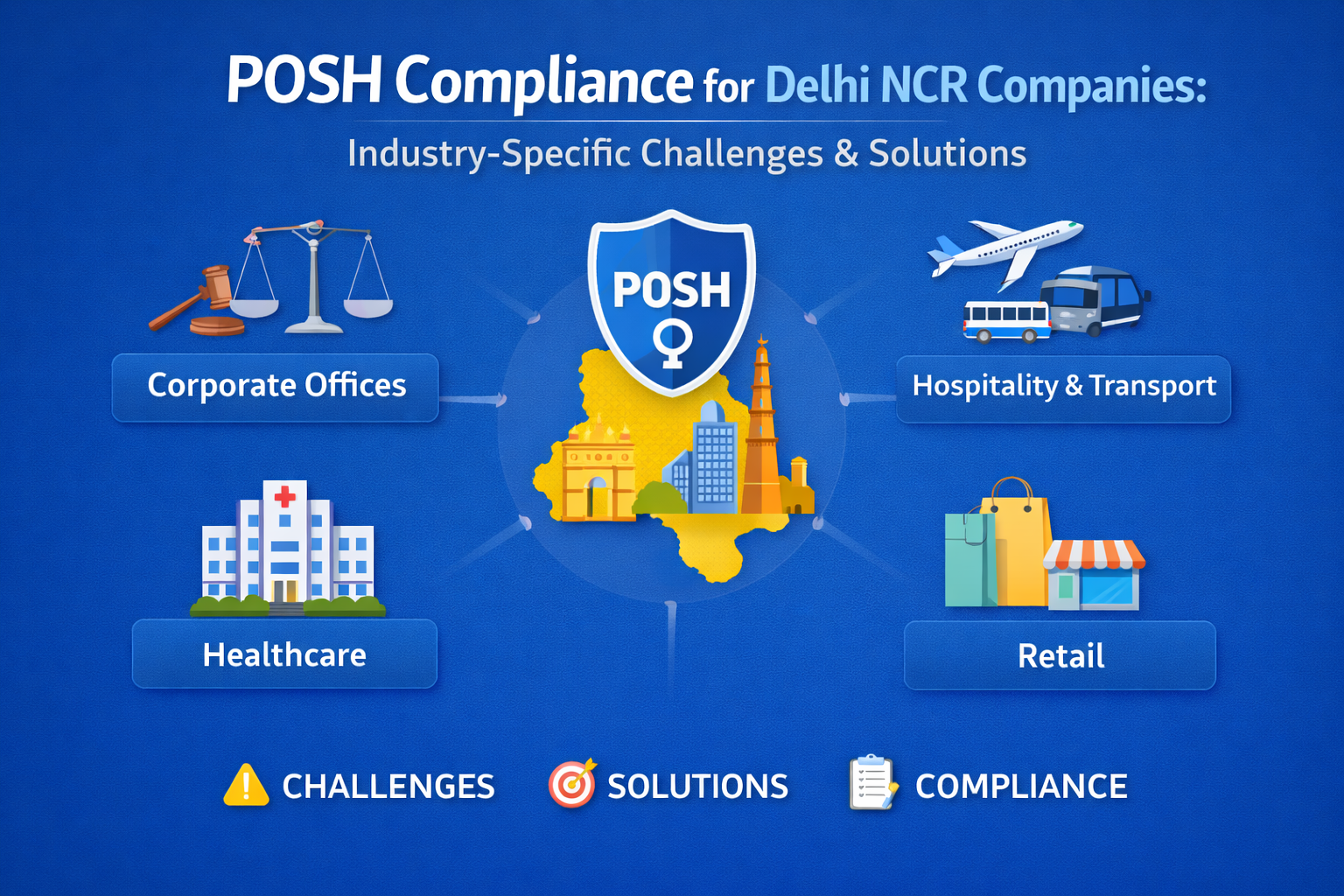
Workplace safety and dignity are now central to corporate governance in India. For organisations operating in Delhi NCR, POSH Compliance for Companies has become an area of heightened regulatory focus due to workforce diversity, sectoral complexity, and increased employee awareness. Employers are expected not only to comply on paper but to demonstrate effective implementation across locations, teams, and working models. Delhi NCR hosts a wide mix of industries including IT services, manufacturing, healthcare, education, startups, and professional services. Each sector faces distinct compliance challenges under the Sexual Harassment of Women at Workplace Act. This article examines those challenges and outlines practical solutions to help organisations strengthen compliance in a region where scrutiny continues to increase.
Understanding the Legal Framework Applicable in Delhi NCR
The Sexual Harassment of Women at Workplace Act 2013 applies uniformly across India. However, enforcement practices and administrative oversight differ at the district level. In Delhi NCR, District Officers actively review compliance records and respond to complaints related to non-constitution of Internal Complaints Committees or procedural lapses. Guidance issued by the Ministry of Women and Child Development clarifies employer responsibilities relating to committee constitution, training, inquiry timelines, and reporting. Employers operating across Delhi, Gurugram, Noida, and Faridabad must also be mindful of jurisdiction-specific filing and reporting practices. Consistency across locations is essential. Variations in implementation often lead to compliance gaps.
Why POSH Compliance Is Particularly Complex in Delhi NCR?
Delhi NCR companies face unique operational realities. High employee mobility, contractual staffing, remote work arrangements, and multi-location operations complicate compliance. In many organisations, employees report to managers in different cities or work on client premises. These arrangements raise questions around jurisdiction, reporting mechanisms, and inquiry authority. Regulators increasingly expect employers to address these complexities proactively rather than relying on generic policy templates.
Understanding POSH Compliance for Companies
POSH Compliance for Companies refers to the structured implementation of statutory obligations under the POSH Act. This includes policy adoption, Internal Complaints Committee constitution, awareness initiatives, inquiry processes, record maintenance, and annual reporting. Compliance is ongoing. It does not end with policy circulation or committee formation. Authorities now examine whether systems function effectively in practice. For Delhi NCR companies, compliance must account for workforce size, industry risks, and operational structure.
Industry-Specific Challenges and Practical Solutions
IT and Technology Companies
IT and technology firms in Delhi NCR often operate with hybrid or remote teams. Complaints may arise during virtual meetings, online chats, or offsite client interactions. A common challenge is defining the workplace clearly. Employers should explicitly extend POSH coverage to digital communication and remote work environments. Clear reporting channels and trained ICC members familiar with virtual evidence handling are essential. Regular awareness sessions help employees understand acceptable conduct in digital spaces.
Manufacturing and Industrial Units
Manufacturing units often employ contract workers, shift-based staff, and third-party vendors. Ensuring POSH compliance across this workforce is challenging. Employers must extend POSH protection to all workers present at the workplace, not only permanent staff. Language barriers and limited awareness increase risk. Solution lies in multilingual awareness programmes, visible display of ICC details, and coordination with contractors to ensure consistent standards.
Healthcare and Hospitals
Hospitals and healthcare facilities operate under high pressure and involve patient interaction. Complaints may involve staff, visitors, or patients. Maintaining confidentiality and neutrality is critical. Inquiry timelines must be balanced with operational demands. Clear internal protocols, trained external members, and sensitivity training for ICC members help address sector-specific risks.
Educational Institutions
Universities and schools in Delhi NCR handle complaints involving faculty, students, and staff. Overlapping roles create complexity. Institutions must clearly define jurisdiction and ensure that committee’s function independently. Awareness programmes should address power dynamics and reporting hesitation. Failure to manage these issues often results in reputational damage beyond regulatory penalties.
Startups and Emerging Businesses
Startups often delay compliance due to resource constraints or lack of awareness. Rapid growth further complicates matters. Early adoption of structured compliance reduces long-term risk. Founders should prioritise ICC constitution once statutory thresholds are met. Engaging expert guidance early prevents costly corrective action later.
Internal Complaints Committee Challenges in Delhi NCR
Many organisations struggle with ICC constitution and functioning. Common issues include expired tenure, inadequate training, or inactive external members. Delhi NCR authorities increasingly examine whether the ICC operates independently and follows due process. Token committees are no longer sufficient. Periodic review and documentation help maintain credibility.
Training and Awareness as a Compliance Tool
Awareness programmes form a core part of compliance. Authorities expect employers to conduct regular sessions and document participation. Training reduces underreporting and clarifies acceptable behaviour. It also strengthens organisational defence during inspections or litigation. For many organisations, awareness initiatives form part of broader compliance under posh act strategies.
Documentation and Record Management
Proper record keeping supports every aspect of compliance. Employers must maintain ICC meeting records, inquiry reports, training logs, and annual filings. In Delhi NCR, inspections often focus on documentation quality. Missing or inconsistent records weaken compliance claims. Secure storage and restricted access protect confidentiality and integrity.
Annual Reporting and Regulatory Scrutiny
Annual POSH reporting is mandatory. Authorities in Delhi NCR increasingly follow up on non-submission or inaccurate filings. Reports must reflect actual inquiry data and awareness initiatives. Nil reports must also be filed where applicable. Aligning reporting with internal records avoids compliance discrepancies.
Role of Expert Support in High-Risk Environments
Complex organisational structures or sensitive cases often require external expertise. Independent review strengthens procedural integrity. Many organisations consult skilled posh consultants in Delhi, India to review compliance frameworks, train ICC members, and audit documentation. Expert involvement also reassures employees of impartiality.
Building a Sustainable Compliance Culture
Effective compliance goes beyond statutory checklists. It requires leadership commitment, consistent communication, and fair enforcement. Senior management involvement signals seriousness. Clear consequences for misconduct reinforce accountability. When compliance becomes part of organisational culture, risks reduce significantly.
Common Compliance Mistakes to Avoid
One frequent mistake is assuming uniform application across industries. Sector-specific risks must be addressed individually. Another error is neglecting periodic review. Compliance frameworks must evolve with workforce changes. Employers should also avoid informal handling of complaints without ICC involvement.
Conclusion
POSH Compliance for Companies operating in Delhi NCR requires more than basic adherence to statutory requirements. Industry-specific risks, workforce diversity, and regulatory scrutiny demand a thoughtful and structured approach. Employers who understand sectoral challenges and implement tailored solutions build safer workplaces and reduce legal exposure. A proactive compliance strategy protects employees and strengthens organisational credibility in one of India’s most regulated business regions.