
Compliance under the Sexual Harassment of Women at Workplace Act goes beyond policy drafting and Internal Complaints Committee functioning. One of the most scrutinised obligations for employers is the Annual Report Process, which requires organisations to formally disclose how complaints were handled during the year. This process is closely monitored by authorities and is increasingly used to assess whether employers are meeting statutory responsibilities in practice. For Indian organisations, understanding the format, timeline, and correct method of filing the POSH annual report is essential. Errors or delays may attract penalties and weaken the employer’s compliance position. This guide explains the annual report process in a structured and practical manner, focusing on accuracy, timelines, and procedural clarity.
Legal Basis for POSH Annual Reporting
The requirement for annual reporting arises under the Sexual Harassment of Women at Workplace Act 2013 and the rules framed under it. Every employer must ensure that the Internal Complaints Committee prepares an annual report summarising complaints received and actions taken during the year. Government advisories issued by the Ministry of Women and Child Development clarify that this report must be submitted to the District Officer having jurisdiction over the workplace. Several district administrations have also issued local instructions on reporting formats and deadlines. The annual report is not a voluntary disclosure. It is a statutory obligation and forms part of official compliance records.
Why the Annual Report Process Matters for Employers?
The annual report process serves multiple purposes. It allows authorities to monitor how organisations address workplace harassment. It also enables employers to review trends, identify gaps, and strengthen internal systems. In recent years, regulatory scrutiny has increased. Authorities now look beyond the existence of policies and focus on implementation. Annual reports provide tangible evidence of compliance. From a governance perspective, the report helps senior management assess whether grievance mechanisms are functioning effectively and whether preventive measures are adequate.
Understanding the Annual Report Process
The annual report process refers to the structured sequence of steps through which an organisation compiles, verifies, and submits its POSH compliance report for the year. This process begins with record review and ends with formal submission to the appropriate authority. It involves coordination between the ICC, HR, and senior management. Accuracy and consistency are critical. Any mismatch between internal records and reported figures may raise compliance concerns. The process should be treated as an annual compliance exercise rather than a last-minute administrative task.
Who Is Responsible for Annual POSH Reporting?
Although the Internal Complaints Committee prepares the report, legal responsibility lies with the employer. Courts and authorities consistently hold employers accountable for non-submission or inaccurate filing. HR teams usually coordinate the process, but senior management oversight is essential. Clear allocation of responsibility prevents delays and omissions. Employers should avoid assuming that the ICC will manage the process independently without organisational support.
Format of the POSH Annual Report
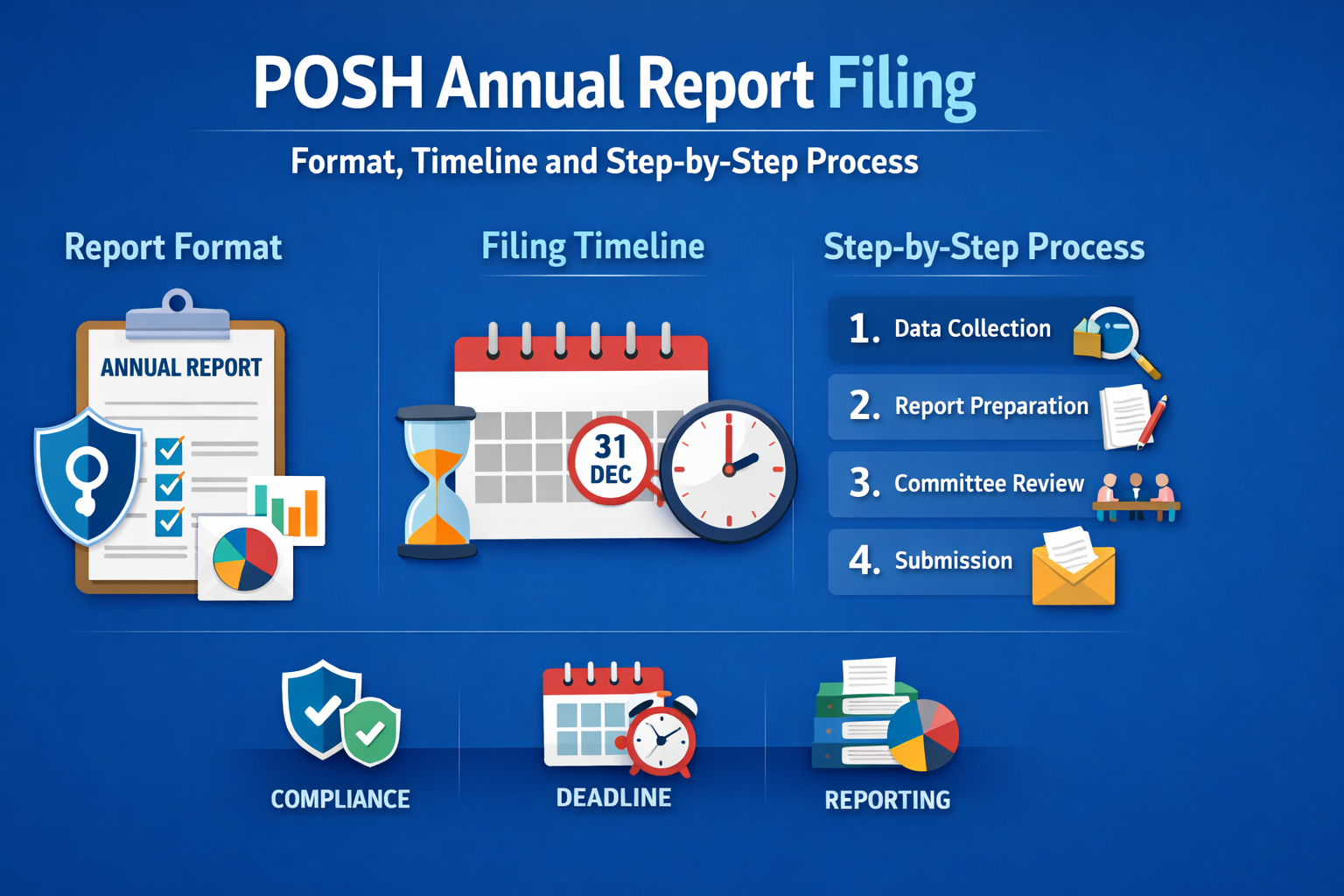
While there is no single nationwide format, most reports follow a similar structure based on statutory requirements and district office guidelines. The report typically includes the number of complaints received during the year, the number resolved, the number pending beyond prescribed timelines, and details of action taken. It also records awareness programmes conducted and any systemic measures adopted. Confidentiality is paramount. Reports must never disclose identities of complainants or respondents.
Preparing Data for the Annual Report
Data preparation is the foundation of accurate reporting. Organisations should begin by reviewing ICC registers, inquiry reports, meeting minutes, and closure records. Consistency across documents is essential. Figures mentioned in the report must match internal records. Any pending matters should be clearly stated rather than omitted. Early data collation reduces pressure near filing deadlines and allows time for internal verification.
Timeline for Annual POSH Report Submission
Timelines vary slightly by jurisdiction, but most authorities require submission early in the calendar year following the reporting period. Employers should confirm deadlines with the District Officer or local administration. Late submission is a common compliance failure. Delays often occur due to internal approvals or incomplete records. Creating an internal compliance calendar helps ensure timely filing every year.
Step-by-Step POSH Annual Report Process
The annual report process follows a logical sequence. It begins with internal record review and ends with formal submission. The first step involves verifying ICC constitution and ensuring the committee functioned in compliance with statutory requirements. The second step focuses on compiling complaint data and inquiry outcomes. The third step involves internal review and approval to confirm accuracy. Once finalised, the report is submitted to the appropriate authority along with any required covering documents. Acknowledgement receipts should be retained for records. This structured approach reduces compliance risk and supports audit readiness.
Common Errors During Annual POSH Reporting
Several recurring errors undermine compliance. One common issue is under-reporting due to informal resolution of complaints. All complaints formally received by the ICC must be reflected. Another error involves missing timelines or submitting reports to the wrong authority. Jurisdiction must be verified carefully. Inconsistent figures between reports and internal records may also attract scrutiny during inspections.
Link Between Reporting and Overall POSH Compliance
Annual reporting is closely linked to broader compliance. Authorities often examine whether organisations have conducted training, maintained records, and followed due process during inquiries. Accurate reporting strengthens the organisation’s compliance narrative and demonstrates good faith. Many employers integrate annual reporting with broader POSH Annual Report Filing workflows to ensure alignment across documentation.
Role of External Review and Expert Support
For organisations handling multiple locations or complex cases, external review can improve accuracy. Expert guidance helps interpret statutory requirements and local administrative practices. Engaging a Certified POSH Consultant during the review stage can help identify gaps and reduce the risk of non-compliance.
Maintaining Confidentiality and Data Protection
Confidentiality obligations apply throughout the reporting process. Only aggregate data should be shared. Personal details must remain protected. Access to reports should be restricted to authorised personnel. Secure storage of records protects both employees and the organisation. Breach of confidentiality can undermine trust and expose the employer to legal consequences.
Using Annual Reports as a Governance Tool
Beyond statutory compliance, annual reports offer valuable insights. Trends may indicate areas requiring policy refinement, additional training, or leadership intervention. Management can use these insights to strengthen workplace culture and prevent future issues. When treated as a governance tool, reporting contributes to long-term organisational resilience.
Conclusion
The Annual Report Process under the POSH framework is a critical compliance obligation for Indian organisations. It reflects how effectively workplace harassment concerns are addressed and whether statutory duties are fulfilled in practice. Accurate reporting, timely submission, and proper documentation protect organisations from regulatory risk and strengthen trust among employees. When approached systematically, annual reporting becomes a valuable governance exercise rather than a compliance burden.